Visit profile

Laboratory for Biopsychological-Experimental Psychological Research
Goals and tasks
Biopsychological methods are increasingly used in psychological research and diagnostics. They have the advantage of being able to capture aspects of human experience and behavior relatively independently of subjective processes. Used in experimental studies, they also serve as a more objective additional source of data.
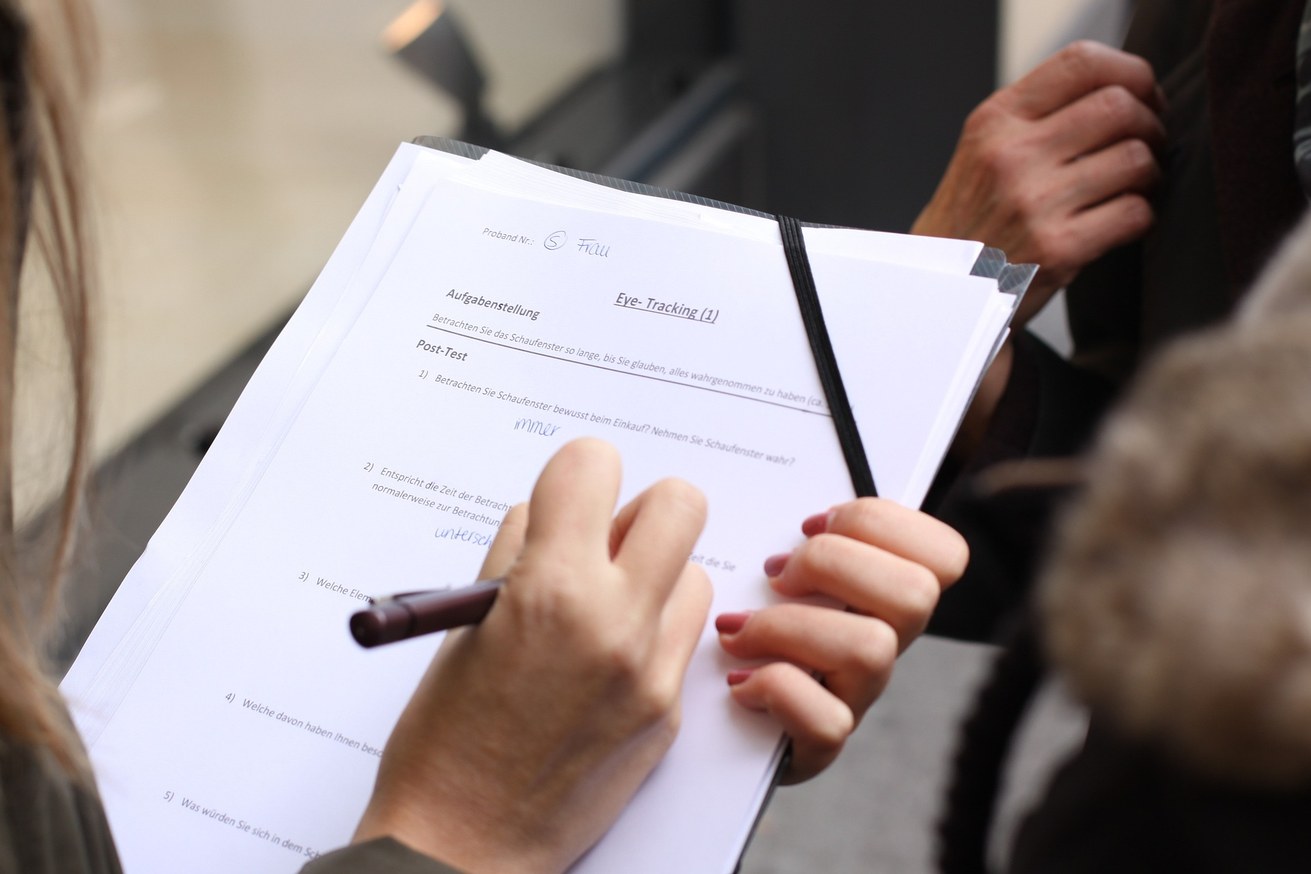
The Laboratory for Biopsychological-Experimental Psychological Research aims to use different biopsychologically based methods (e.g. eye tracking) as well as the recording and analysis of physiological parameters (e.g. skin conductance, heart rate, stress and sex hormones in saliva) in the context of psychological diagnostics and research. However, AI methods such as facereader will also be used in the laboratory.
In addition, these diagnostic methods and their possible applications will be further developed in a targeted manner. In this way, especially students of the 2-subject Bachelor of Psychology will get the opportunity to become familiar with these special methodologies and to use them for their own research, e.g. in the context of empirical internships or bachelor theses.
Laboratory-based studies and qualification theses:
Kirsch, M. (2025). Physiologische Korrelate kognitiver Beanspruchung: Das tonische Skin Conductance Level im Kontext mentaler Rotation [Physiological correlates of cognitive load: Tonic skin conductance level in the context of mental rotation]. Bachelor’s thesis in Psychology (Double-Subject Bachelor’s degree).
Tietz, A. (2025). Visuelle Aufmerksamkeit und kognitive Belastung in mentalen Rotationsaufgaben: Eine Eye-Tracking Studie [Visual attention and cognitive load in mental rotation tasks: An eye-tracking study]. Bachelor’s thesis in Psychology (Double-Subject Bachelor’s degree).
Arull, S. (2025). Der Einfluss induzierter Emotionen auf die Risikobereitschaft: Eine experimentelle Untersuchung mit physiologischer Validierung [The effect of induced emotions on risk taking: An experimental study with physiological validation]. Bachelor’s thesis in Psychology (Double-Subject Bachelor’s degree).
Lennon-Maslin, M. (2025). Bridging Gaps! : Spatial Ability Development in the Primary School Years and Its Relation to Affective and Academic Measures in STEM Learning in Boys and Girls. Koblenz: Universität Koblenz. Retrieved from https://opus4.kobv.de/opus4-uni-koblenz/files/2533/Dissertation+Final+MLENNONM+17.12.2024.pdf
Saunders, M. (2024). Blickanalysen bei mentalen Rotationsaufgaben [Gaze analyses in mental rotation tasks]. Koblenz: Universität Koblenz. Retrieved from https://kola.opus.hbz-nrw.de/files/2461/Dissertation+Mirko+Saunders.pdf
Schmidt, Ch. (2021). Der Einfluss von Infraschall auf die kognitive Leistungsfähigkeit, das subjektive Wohlbefinden und das Stresslevel [The effect of infrasound on cognitive performance, subjective well-being, and stress level]. Bachelor’s thesis in Psychology (Double-Subject Bachelor’s degree).
Geiß, M. (2019). Hashtag Prokrastination. Psychophysiologische Untersuchung von Stress und Beurteilung bei Prokrastination [Hashtag procrastination: Psychophysiological investigation of stress and appraisal in procrastination]. Bachelor’s thesis in Psychology (Double-Subject Bachelor’s degree).
Schmidt, S. (2019). Was löst Prokrastination im Körper aus? Eine psychophysiologische Untersuchung von Stress und negativer Beurteilungen Prokrastination [What does procrastination trigger in the body? A psychophysiological investigation of stress and negative appraisals in procrastination]. Bachelor’s thesis (Double-Subject Bachelor’s degree).
Klotz, L.-M. (2019). Mentale Rotation von Kindern im Kindergartenalter: Eine Studie zu Einflussfaktoren unter besonderer Berücksichtigung der Strategie [Mental rotation in kindergarten-aged children: A study of influencing factors with a particular focus on strategy]. Bachelor’s thesis in Psychology (Double-Subject Bachelor’s degree).
Hippler, N. (2018). Neuropsychologische Aspekte einer akuten C2-Intoxikation unter besonderer Berücksichtigung der konjugierten Okulomotorik im subklinischen Stadium [Neuropsychological aspects of acute C2 intoxication with special consideration of conjugate oculomotor function in the subclinical stage]. Bachelor’s thesis in Psychology (Double-Subject Bachelor’s degree).
UNIVERSITY OF KOBLENZ
Universitätsstraße 1
56070 Koblenz
© Universität Koblenz