Prof. Dr. Stefan Bosse
Head of the Practical computer science Research Group


Science and Creating Knowledge
Sensors, Sensornetworks, Materialintegrated Sensorial Systems
In research, we dealt with the processing of sensor data in the broadest sense. The work is interdisciplinary and takes place in close cooperation with the engineering sciences, electrical and microsystems engineering, production engineering, and even the social sciences. The focus is on microcomputers that are smaller than a pinhead. We try to map and scale classical concepts of computer science and machine learning to these small computers, often supported by strong networking. Virtualization on and with these microcomputers is an important link for broad usability and robustness and is to be understood as a modern operating system. Finally, we are interested in integrating these computers into materials and technical components (material-integrated sensory and intelligent systems), for example, to enable structural monitoring as an application.
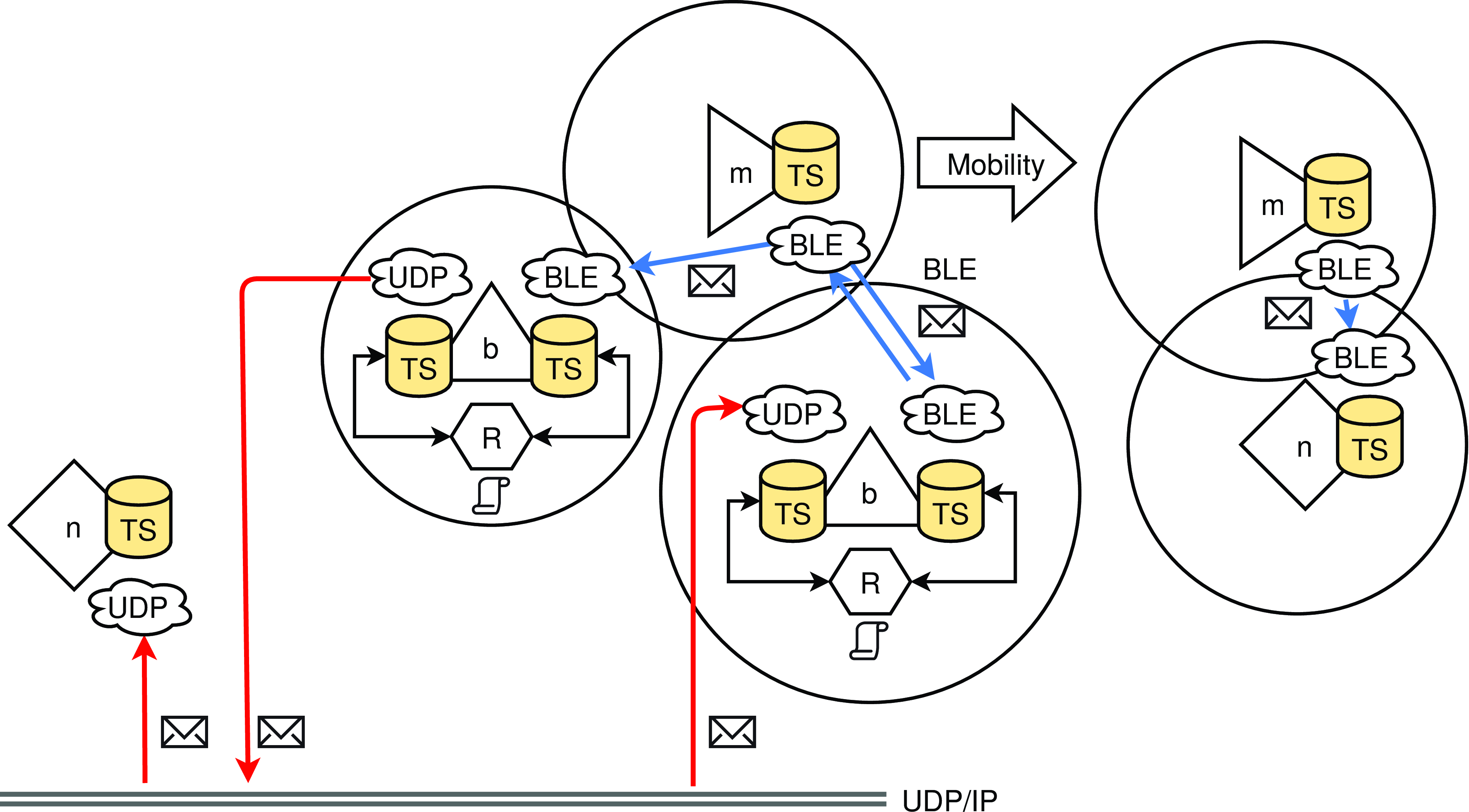
Wireless Agent-based Distributed Sensor Tuple Spaces using Bluetooth and IP Broadcasting http://dx.doi.org/10.15439/2022F119
A mobile ad-hoc sensor network using Bluetooth communication with distributed tuple spaces as data storage. Beacons (b) serve as an intermediate host for data that can either be delivered or taken by passing devices. The communication uses Bluetooth broadcasting and advertising for two-way communication between devices.
Organic Electronics and Additive Manufacturing
New additive manufacturing technologies (printing technologies) allow the production of electronic components on a small scale and printing on any materials, and therefore we are also dealing with analog computers that can be designed with such (organic) electronic components. Unfortunately, these electronic circuits with printed transistors are difficult to design classically due to unreliability and parameter scattering, and we want to use modern algorithms such as evolutionary and genetic algorithms, as well as simulative methods to integrate these analog computers meaningfully and reliably into digital systems (as co-processors). The central technology is organic electronics, which can be produced in our own laboratory using printing processes. Here, too, virtualization plays a central role as abstraction.
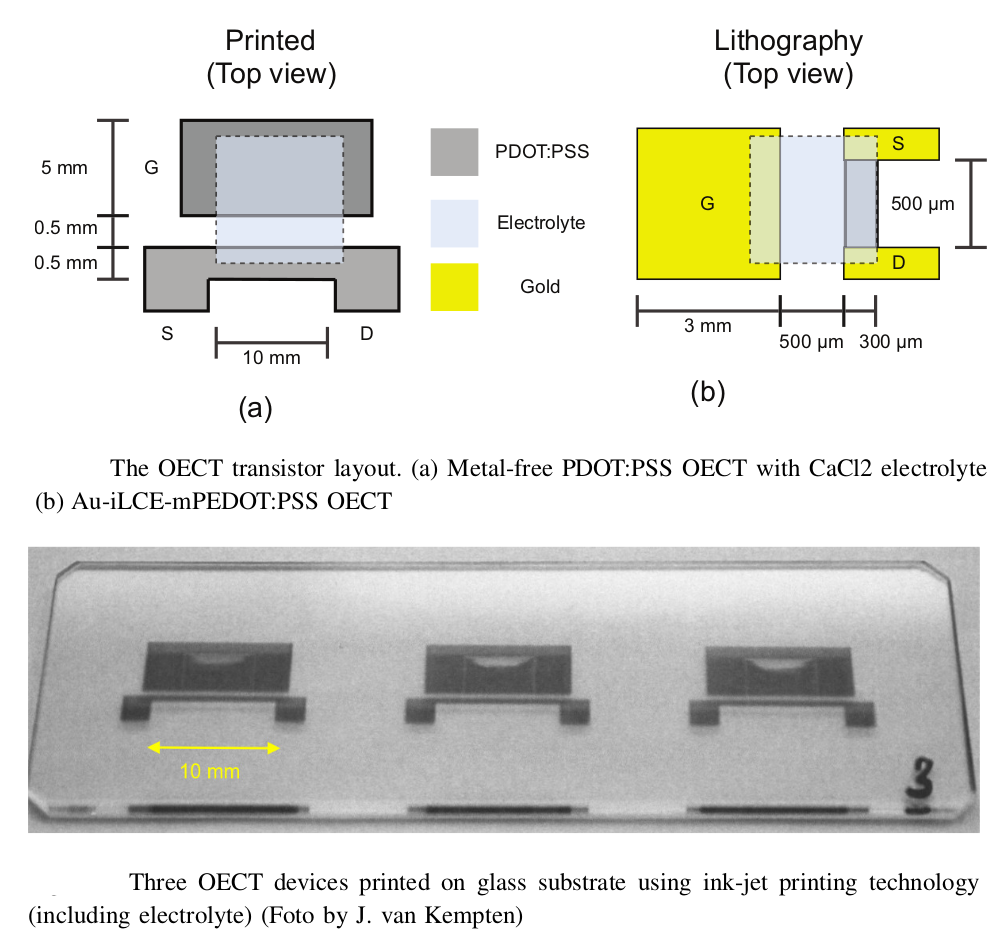
Electronics 2026, 15(21), 4888;https://doi.org/10.3390/electronics15214888
Layout and manufactured examples of Organic Electrochemical Transistors. Still relatively large ("for convenience "), but it can also be smaller.
Analog Computing
Computer science deals with the processing of digital data with digital computer systems. But isn't there another way? Snesor signals are generally analog, i.e. continuous in value and time. These analog signals must first be digitized for digital systems, which always means a loss of information. We are dealing with the question of whether these sensor signals can not be processed immediately with analog systems and analog computers. We use conventional electroink based on silicon and organic electronics as technologies. We research architectures and algorithms for the design of analog computers. AI and artificial neural networks can also be implemented completely analogously. The advantage can be a much lower resource requirement. And analog circuits are currently the only ones that can be meaningfully implemented with organic electronics due to the still low integration densities, especially with the digital printing technologies we use (ink-jet material printing) and screen printing.
According to Bernd Ulmann, a pioneer of analog computing technology in the postmodern age: "There can only be analog. Digital is under-complex and not human enough either.«
Analog computer systems simulate physics. Thus, they can be used directly for the calculation and solution of differential equations by implementing these differential equations with operational amplifiers.
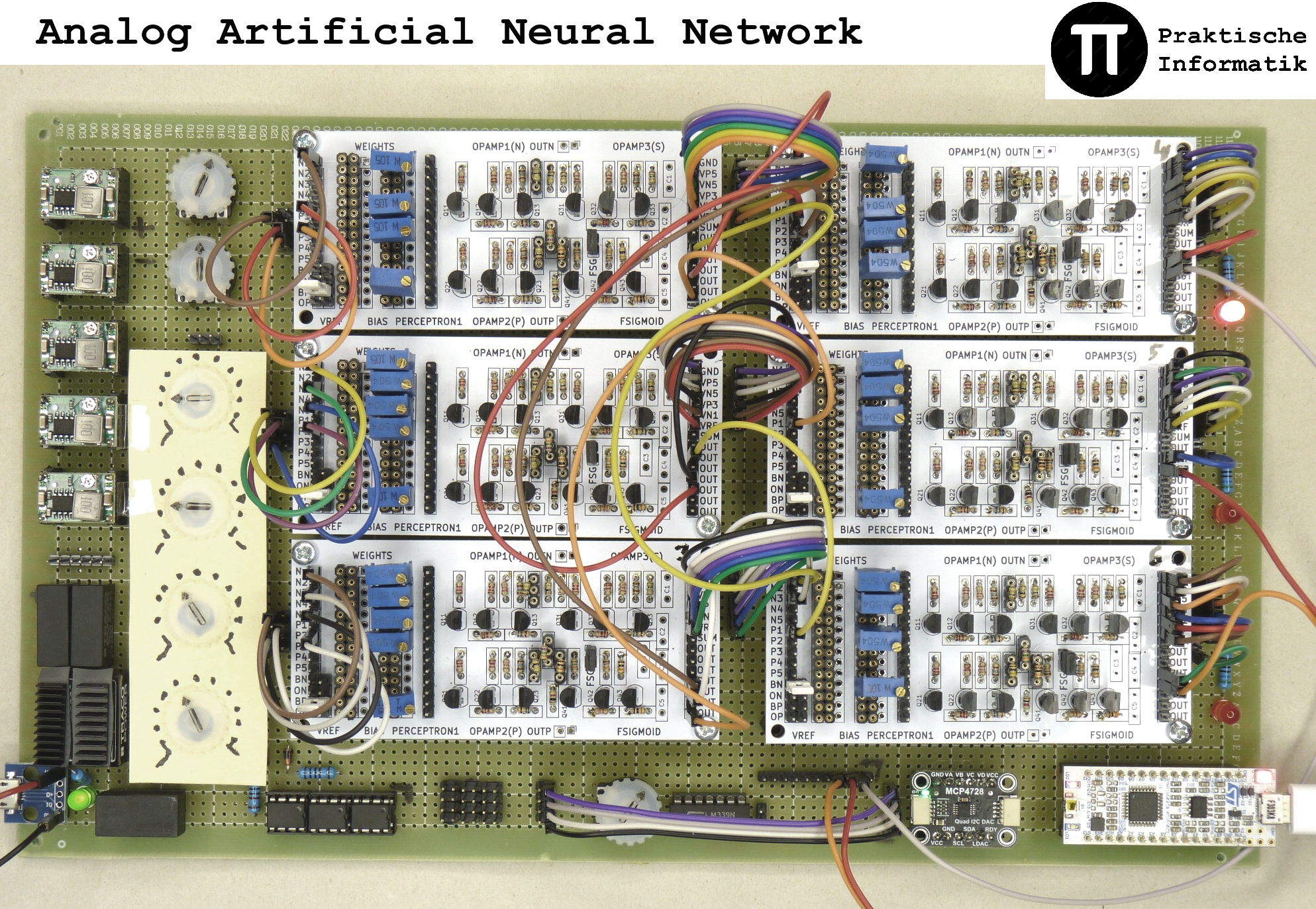
Design of Analog Computers: Building Blocks and Advanced Methods for Tiny Analog Machine Learning with Surrogate Modeling https://doi.org/10.1016/j.procs.2026.02.028
An analog Artificial Neural network, used here to classify the IRIS dataset in a purely analog way. The input is four voltages 0-1V, which determine the four IRIS property variables, the output is three signals (0V-3V), which represent the versicolor, verginica, and setosa classes. The AKNN consists of a total of 36 transistors (6 neurons), a microprocessor for the digital calculation of a KNN needs at least 10000 transistors.
Explainable AI and Generative Modells
Data-driven methods, known as machine learning, require data. Not just any, but high-quality data that covers a large parameter space so that models do not specialize. However, experimental data are often sparse and synthetic data or signal generation is required. In addition to the simulation that we use in the field of ultrasonic measurement technology with discrete solutions for viscoelastic wave equations, we deal with generative models to be able to generate sensor signals synthetically. But this is where the problems begin. The signal data should be plausible and physically correct, as well as the experimental sensor data. This is the field of explainable AI, in particular the comprehensibility of black box models, plausibility, inter- and extrapolation capability, parameter space coverage and physical explainability of predictive and generative ML models. Examples are the well-known Generative Adversarial Networks (GAN), diffusion models, and autoencoder-based models, all of which are intended to generate new data using stochastic processes, and that can be controlled as parametrically as possible.
Data-driven Parameterizable Generative Adversarial Networks for Synthetic Data Augmentation of Guided Ultrasonic Wave Sensor Signals https://doi.org/10.58286/29787
Demonstration of the reality gap using an example of the propagation of ultrasonic waves in materials (here aluminum plate with a round error): (left) Simulation of the wave field (right) Wave field of a real sample measured with air ultrasound (fiber-metal-laminate plate)
Teaching
In teaching, we offer the classic courses "Fundamentals of Operating Systems" and "Algorithms and Data Structures", which together represent a base of computer science and are the basis for computer systems used every day. In addition to formal methods, the practical implementation and programming of operating systems will be taught on the basis of experiments and laboratory exercises.
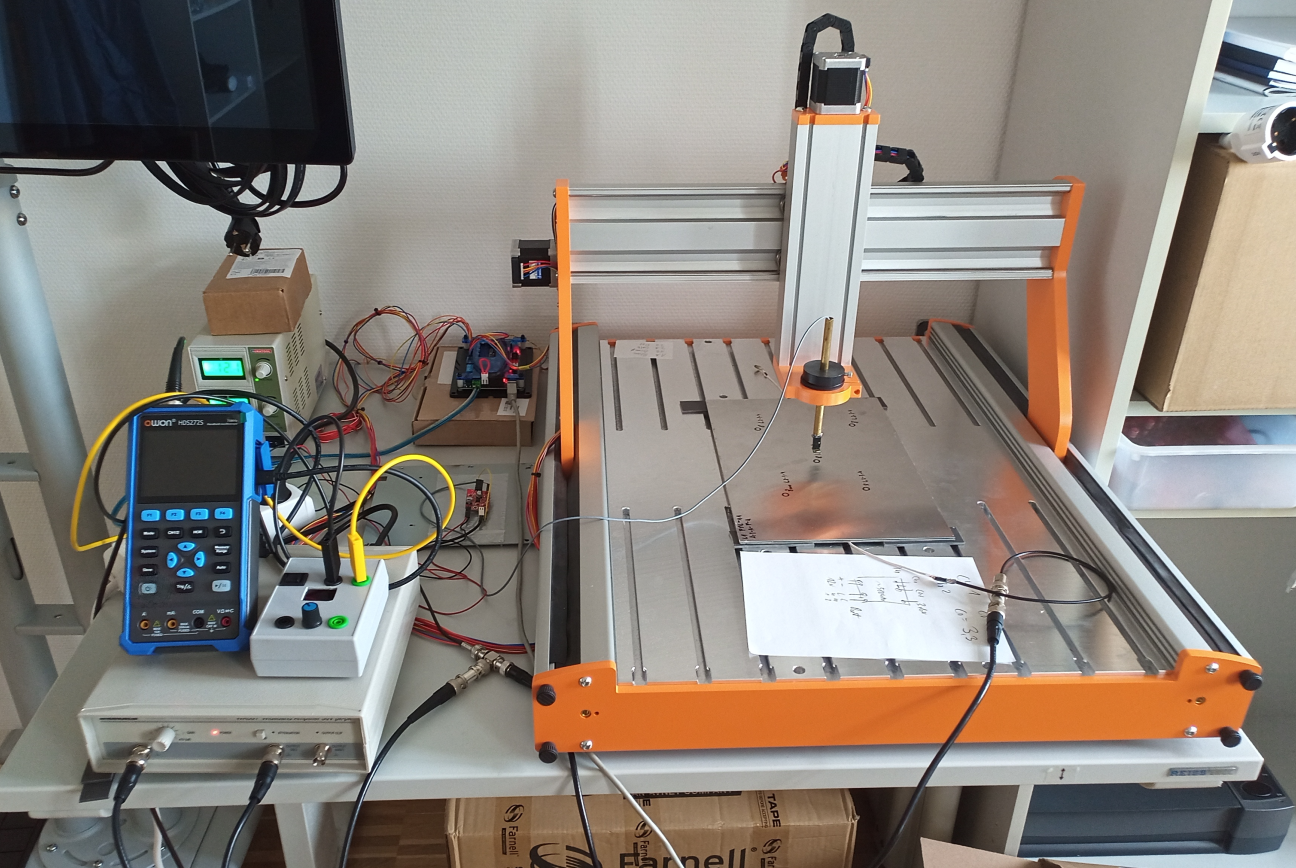
A measuring system for the automated and spatially resolved examination of samples with air ultrasound testing technology to detect hidden damage in materials, here using the example of self-manufactured fiber-metal laminate boards, which are particularly challenging in damage diagnostics..
The main research area contains virtualization in sensor networks and mobile network environments, generative models and procedures for synthetic generation of sensor data, distributed artificial intelligence, and analogous computation (analog computer), as well as organic electronics and printing processes
We combine computer science with technologies. For example, we are engaged in electronics design, additive manufacturing of organic electronics, and the construction of measuring and testing systems.
A printing laboratory is available for additive manufacturing, where, in addition to screen printing, drop-on-demand technologies ("ink-jet", microdispenser) are also used to be able to produce functional 3D structures.
The focus of measurement and testing technology is on obtaining measurement data for algorithmic processing and machine learning. We use various measuring methods, e.g. ultrasound or eddy current technology to be able to investigate hidden properties of materials (damage diagnostics, NDT).
UNIVERSITY OF KOBLENZ
Universitätsstraße 1
56070 Koblenz
© Universität Koblenz