UNIVERSITY OF KOBLENZ
Universitätsstraße 1
56070 Koblenz

The VisSim team is proud to have contributed two publications to AMLDS 2025:
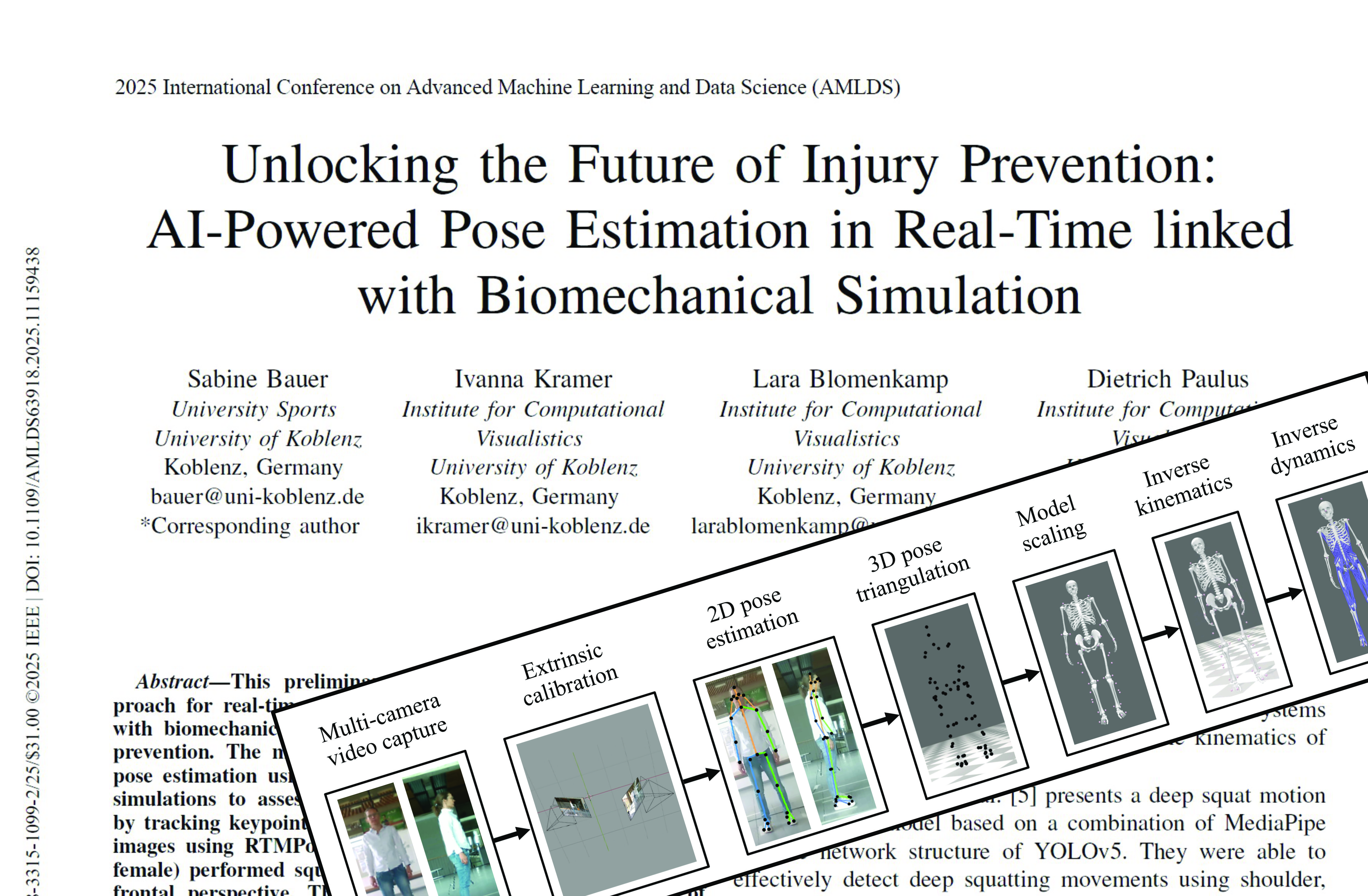
This study introduces an AI-based approach for real-time pose estimation combined with biomechanical simulation to enhance personalized injury prevention. The method integrates dual-camera pose tracking (hip, knee, ankle, foot tip) using the RTMPose model with biomechanical simulations to assess joint angles and musculoskeletal loads. Twelve participants (6 male, 6 female) performed squats recorded from both frontal and lateral views. Results demonstrate high accuracy, with mean absolute errors ranging from 3.49° to 4.15°, and reliable simulation of knee angles and muscle force distribution. The system provides real-time feedback on squat execution, enabling users to adjust their posture based on kinematic and biomechanical data — a step toward individualized, real-time biomechanical assessment.
✨ Highlight: The presentation of this work earned Dr. habil. Sabine Bauer the Best Presentation Award at the conference.
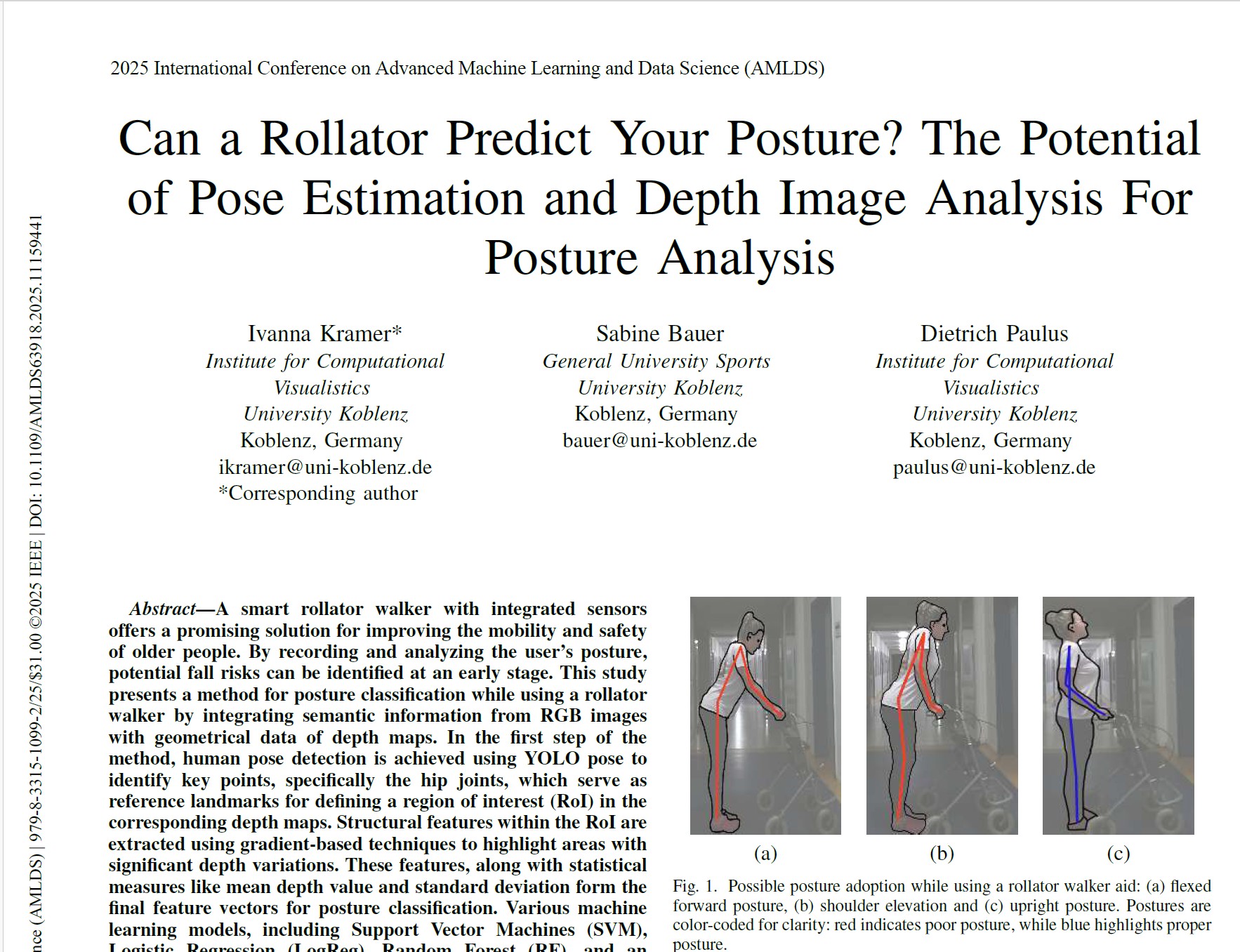
2. Can a Rollator Predict Your Posture? The Potential of Pose Estimation and Depth Image Analysis for Posture Analysis
👉 Read the publication
This work presents an innovative sensor-integrated smart rollator designed to improve the mobility and safety of older adults. By combining RGB image-based human pose detection (YOLO) with depth image analysis, the system identifies key landmarks (hip joints) and extracts structural features from depth variations to classify posture. Multiple machine learning models were tested (SVM, Logistic Regression, Random Forest, XGRF ensemble), with Random Forest and XGRF achieving the best performance: accuracy of 0.85, precision of 0.89/0.88, and recall of 0.83. These results demonstrate that a smart rollator can reliably distinguish between good and poor posture, offering a promising tool for early detection of fall risks.
UNIVERSITY OF KOBLENZ
Universitätsstraße 1
56070 Koblenz
© Universität Koblenz