UNIVERSITY OF KOBLENZ
Universitätsstraße 1
56070 Koblenz

‘By integrating AI and optimising key manufacturing processes, we are making an important contribution to increasing efficiency in the ceramics industry,’ said Economics Minister Daniela Schmitt. ‘The project shows once again how research institutes and companies in Rhineland-Palatinate are working together successfully to make our industry fit for the future. The ceramics industry is highly valued and is an important location factor in Rhineland-Palatinate. 3D printing technology and the application of AI offer enormous potential – both for Rhineland-Palatinate as a business location and for the international competitiveness of our industry.‘
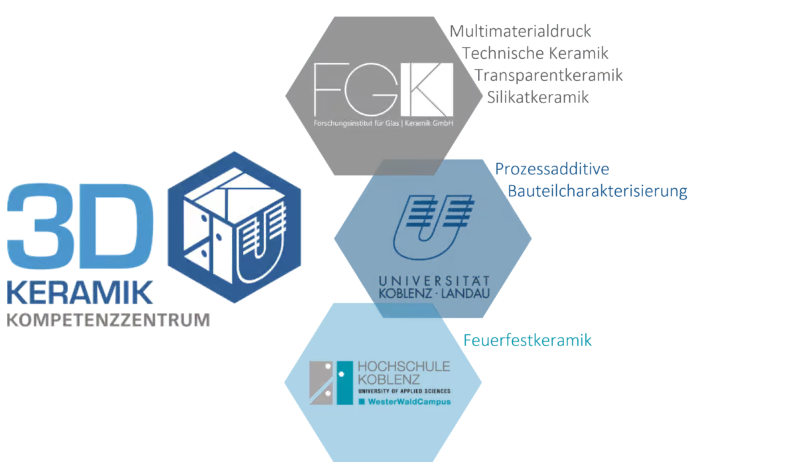
The funding will further advance the integration of artificial intelligence and resource-saving processes in order to significantly increase process stability, manufacturing efficiency and the quality of ceramic components. To this end, the competence centre will be equipped with advanced 3D printing methods and modern analysis tools. The project is supported by a consortium consisting of the University of Koblenz, Koblenz University of Applied Sciences, Trier University of Applied Sciences and the Research Institute for Glass and Ceramics GmbH. Computer science, chemistry and engineering are working closely together to enable direct technology transfer into industrial practice.
Prof. Stefan Wehner, President of the University of Koblenz, emphasised: ‘For the first time, it is now possible to evaluate production-related parameters in ceramic 3D printing through targeted process control and the use of artificial intelligence in such a way that a permanently improved production process is achieved in the end. This will sustainably improve the industrial use of 3D technology and make it comprehensibly more reliable for ceramic manufacturers.’
‘This project is a wonderful example of thinking outside the box: it combines expertise across locations, disciplines and institutions – for the benefit of the economy and the good of our country,’ emphasised Minister of Economic Affairs Daniela Schmitt.
The competence centre has already established itself as an important point of contact for small and medium-sized enterprises that want to use or develop additive manufacturing technologies for ceramic applications. The new project will further strengthen the spread of 3D printing in the ceramics industry, which will further increase the innovative strength and competitiveness of companies in Rhineland-Palatinate.
‘We are taking another step into the future of manufacturing technology. It is an investment in innovation, sustainability and the competitiveness of our industry,’ Schmitt concluded.
UNIVERSITY OF KOBLENZ
Universitätsstraße 1
56070 Koblenz
© Universität Koblenz