Zum Profil
Projektpraktikum / Research lab
Development and Evaluation of a Digital Twin Scenario for Sustainable Building Renovation and Municipal ResilienceProjekt- Forschungspraktikum Digital Twin
For the Master’s program in Wirtschaftsinformatik, the course can also be taken as the “Projektseminar E-Government.” In this case, the focus is on developing a scientific paper within the context of the assigned topic.
Organisation
Students from the following Bachelor's or Master's programs: Information Management / Digital Business Management, Wirtschaftsinformatik, Informatik, Computervisualistik, E-Government, Web and Data Science, Computational Social Science
Schedule: Kick-Off will be organized once at least 6 students are registered in KLIPS; Regular Meetings every 2-3 weeks
Registration in Klips: currently open
Kick Off session: t.b.a. Date will be coordinated with interested students registered, when at least persons are registered in Klips
Background & Point of View
Small municipalities, particularly in rural areas, face major challenges in maintaining and transforming their existing building stock. Many residential buildings were constructed several decades ago and require gradual renovation and modernization. At the same time, demographic change, limited financial resources, sustainability requirements, climate adaptation, and increasing demands regarding municipal resilience make long-term planning increasingly important. These challenges are particularly relevant in rural municipalities, where many buildings are privately owned and renovation needs often intersect with different social and demographic circumstances. Older residents, people with disabilities or other accessibility needs, families, as well as new residents moving into the municipality may have very different requirements regarding housing, renovation, accessibility, energy efficiency, and available support. Necessary renovations therefore cannot always be implemented at once but often take place incrementally over longer periods. For municipalities, a better understanding of the condition and future renovation needs of the local building stock could enable more proactive and socially responsive planning. It could help identify where information, advisory services, funding opportunities, accessibility measures, or other forms of support may be needed and how these needs may develop over time. At the same time, such information could support municipalities in considering how existing buildings can remain suitable for current residents while also becoming attractive and adaptable for families and new residents. Municipalities currently have only limited possibilities to obtain such an integrated and forward-looking picture. A Digital Twin could help bring together relevant building, spatial, and demographic data, explore future renovation needs and scenarios, and provide a basis for developing targeted municipal strategies that connect sustainable building transformation with the changing needs of local communities.
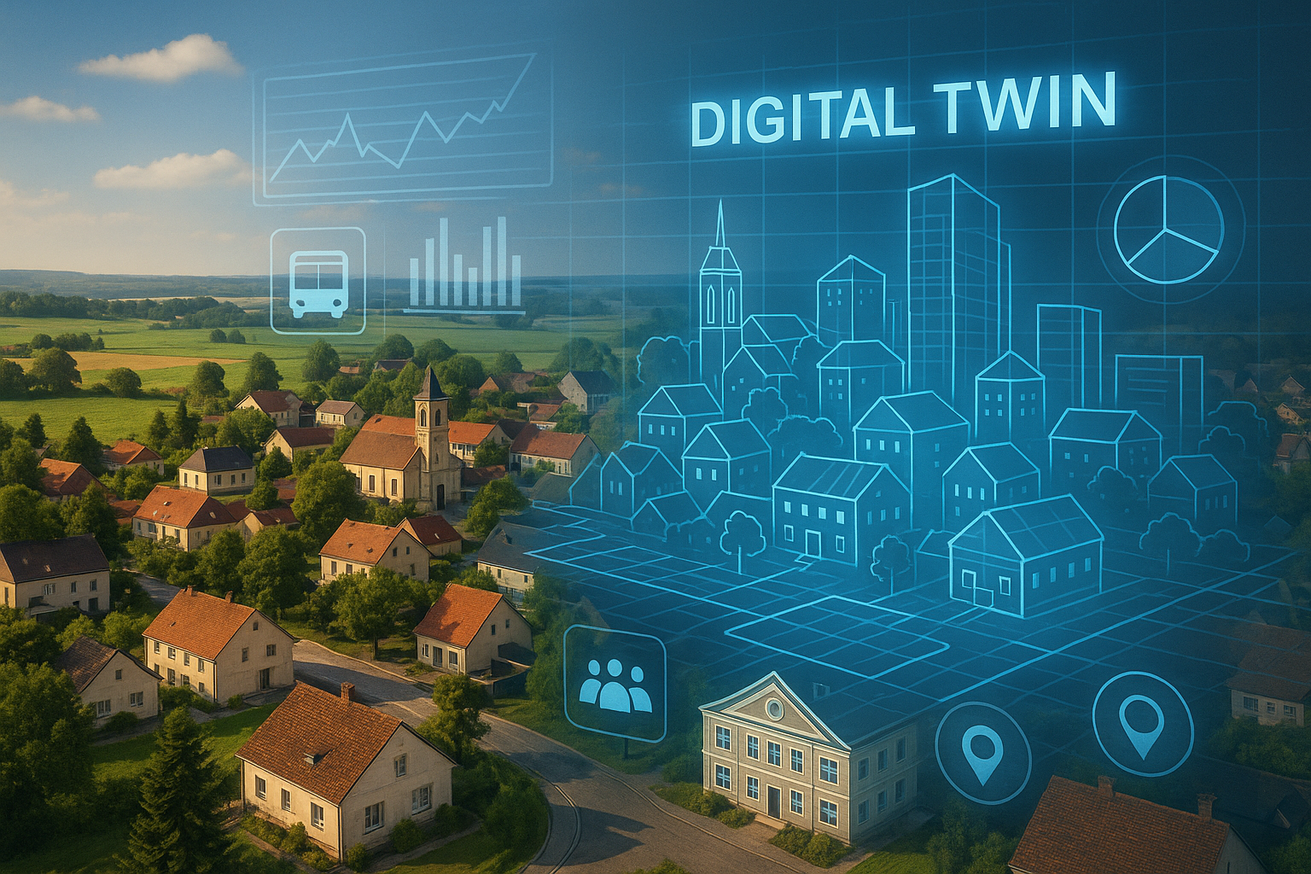
The project DiTKo – Inclusive Digital Twin for Small Municipalities investigates how Digital Twin concepts can be adapted to the specific requirements of small and rural municipalities. Within this research internship, a specific scenario will be investigated: How can a municipal Digital Twin support the analysis, simulation, and long-term planning of building renovation, sustainability measures, and resilience in rural municipalities?
The basic idea is to create a digital representation of the municipality and its building stock and to combine this representation with relevant building, spatial, environmental, and municipal data. Depending on data availability, relevant information may include, for example, building age, building type, roof and façade characteristics, renovation status, heating systems, energy-related characteristics, insulation measures, potentially relevant building materials, spatial proximity between buildings, and other characteristics relevant to municipal planning. The Digital Twin should not merely visualize the current situation. Instead, the research will investigate how such information can be transformed into meaningful scenarios and simulations of (alternative) evolutions over time that support municipalities in understanding possible future developments.
Research Perspective
The project intern / research intern focuses on the conceptual development and empirical evaluation of a building-related Digital Twin scenario for small municipalities.
Possible research questions include:
- Which building-related data are required to model renovation and modernization needs in a municipal Digital Twin?
- How can heterogeneous building, geospatial, environmental, and municipal data be integrated into a suitable data model?
- How can renovation cycles and potential future renovation needs, for example concerning roofs, façades, heating systems, or energy efficiency measures, be represented?
- How can different renovation strategies be translated into scenarios and compared over time?
- How can sustainability measures, such as improved insulation, changes in heating technologies, or energy-related renovation, be incorporated into the Digital Twin?
- How can information on potentially relevant legacy building materials, such as asbestos-containing roofing, be represented appropriately where reliable data are available?
- How can spatial characteristics such as building density and distances between buildings contribute to municipal resilience and risk-related scenario analysis?
- How can aggregated scenarios support municipalities in considering events such as fires or other local hazards without replacing specialist risk assessments?
- Which information and visualizations are useful and understandable for municipal decision-makers and citizens?
- What data quality, uncertainty, privacy, ethical, and governance requirements need to be considered when developing such a Digital Twin scenario?
A particular research interest lies in the transition from a static digital representation of the building stock toward a scenario-oriented Digital Twin capable of exploring alternative future developments.
The Project & Research Intern – Your Role and Responsibilities
- Systematic and structured literature review on Digital Twin research including buildings modelling in cities and municipalities
- Analysis of existing approaches to building lifecycle management, renovation planning, energy-related building assessment, and urban or municipal Digital Twins
- Identification of relevant building and geospatial data models and data sources
- Analysis of approaches for predictive maintenance and long-term renovation planning
- Investigation of existing simulation approaches concerning energy efficiency, building transformation, and municipal resilience
- Identification of research gaps regarding the application of such approaches in small and rural municipalities
1. Scientific Foundation & State of the Art: The first part of the lab will establish the scientific foundation of the scenario. Tasks may include:
The objective is to derive a scientifically grounded conceptual framework for a building-oriented municipal Digital Twin.
- Interviews with municipal representatives and other relevant stakeholders
- Workshops with partner municipalities
- Analysis of existing municipal datasets and data sources
- Identification of typical building and renovation challenges in rural municipalities
- Assessment of currently available information concerning the local building stock
- Identification of information gaps and data quality issues
- Collection and prioritization of relevant use cases
- Validation of conceptual models and prototype components with municipal stakeholders
2. Empirical Research with DiTKo Partner Municipalities: An essential component of the research intern is the empirical investigation together with partner municipalities participating in the DiTKo project. Students will investigate current municipal practices, available data, information needs, and potential application scenarios for the scope of the digital twin on buildings lifecycle monitoring. Depending on the specific research design, activities may include:
The empirical work should provide evidence on which functionalities of a Digital Twin would create practical value for small municipalities and which limitations need to be considered.
3. Data Model & Digital Twin Concept: Based on the literature review and empirical findings, a conceptual data model for the scenario will be developed. The model may connect information on:
- buildings and building types
- construction periods
- roofs and façades
- renovation history
- heating technologies
- insulation and energy-related characteristics
- relevant construction materials
- geospatial information
- distances and spatial relationships between buildings
- environmental and hazard-related information
- demographic or socio-spatial indicators where appropriate and legally permissible.
An important aspect will be determining which information can realistically be obtained, which information would have to be estimated, and how different levels of data quality and uncertainty should be represented.
4. Scenario Development & Simulation: Based on the conceptual model, different scenarios will be developed and, where feasible, implemented as an initial prototype. Possible scenarios could investigate questions such as:
Renovation planning:
Which buildings or building groups may require particular renovation measures within different future time horizons?
Energy transition:
How would different rates of insulation improvement or heating-system replacement affect the municipality's building stock over time?
Renovation pathways:
What happens if renovation measures are implemented gradually over 5, 10, 15, or 20 years?
Demographic change:
How could demographic developments influence the feasibility and prioritization of renovation activities?
Building materials:
How can buildings with potentially relevant legacy materials be identified and incorporated into long-term municipal planning where suitable data exist?
Municipal resilience: How can spatial relationships between buildings and other local characteristics be represented to support scenario-based analyses of fires or other hazards?
The purpose is not to predict the future with certainty. Instead, the Digital Twin should enable municipalities to explore transparent “what-if” scenarios and understand the consequences of different assumptions and development pathways.
5. Prototype & Visualization
Depending on the technical orientation of the student or project team, selected elements of the concept may be implemented as a prototype. Possible components include:
- GIS-based visualization of the building stock
- interactive building information
- visualization of renovation status and potential future renovation needs
- timeline-based simulation of renovation measures
- comparison of alternative renovation scenarios
- visualization of energy-related transformation pathways
- representation of uncertainty and incomplete data
- scenario-based spatial analyses
- dashboards for municipal decision-makers
- interactive exploration of “what-if” scenarios
The prototype does not need to constitute a complete operational Digital Twin. Instead, it should demonstrate selected concepts and provide a basis for evaluating their feasibility and usefulness.
Evaluation
The developed concept and/or prototype will be evaluated together with selected DiTKo partner municipalities. The evaluation may investigate:
- perceived usefulness for municipal planning
- comprehensibility of the presented information
- relevance of the proposed scenarios
- availability and quality of required data
- usability of visualizations
- trust in simulated or estimated information
- requirements concerning transparency and explainability
- privacy and data-governance considerations
- possibilities and limitations for transferring the approach to other small municipalities.
The results of the evaluation will be used to refine the Digital Twin concept and derive recommendations for further developments in the DiTKo project.
Expected Research Outcome
The project / research intern should result in a scientifically grounded and empirically validated concept for integrating building renovation, sustainability, and municipal resilience scenarios into a Digital Twin for small municipalities. Depending on the selected focus, expected outputs may include:
- a structured literature review
- an empirical requirements analysis
- a catalogue of municipal use cases
- a building-related Digital Twin data model
- a scenario catalogue
- a simulation concept
- a prototype or demonstrator
- an evaluation with DiTKo partner municipalities
- and recommendations for future research and implementation.
Requirements for Participants
- Interest in Digital Twins, Smart Cities/Smart Regions, GIS, or data-driven municipal planning
- Basic knowledge of data analysis and visualization
- Experience with common data formats such as CSV, JSON, XML, GeoJSON, or similar formats
- Basic programming skills, for example in Python, R, JavaScript, or comparable languages
- Experience with GIS tools such as QGIS is beneficial
- Interest in simulation, data modelling, or AI-supported analysis is beneficial
- Interest in systematic and structured literature analysis
- Interest in qualitative and/or quantitative empirical research
- Willingness to conduct interviews, workshops, or surveys with municipal stakeholders (German Language necessary)
- Ability to structure and analyse complex requirements
- Interest in translating empirical findings into technical and conceptual solutions
Motivation to work with municipalities and local stakeholders
Willingness to participate in workshops and citizen engagement formats
Open, dialogue-oriented mindset – also when working with non-technical audiences
Ability to present results clearly (presentations, visualizations, documentation)
Reliable working style and independent time management
Ability to collaborate within interdisciplinary teams (e.g., IT, administration, social sciences)
Interest in practice-oriented research with societal relevance
Technical Understanding & Data Competence
Scientific & Empirical Work
Cooperation & Communication
Project & Teamwork Skills
Not all of these skills are mandatory. The specific focus can be adapted depending on the student's background and research interests.
Your Benefits
- Hands-on experience with Digital Twin technologies and real-world municipal data
- Collaboraive work within DiTKo partner municipalities
- Practical experience in GIS, data modelling, simulation, and visualization
- Insights into sustainable building renovation and municipal resilience
- Experience in empirical research through interviews and workshops
- Opportunity to develop and evaluate a real-world Digital Twin use case
- Interdisciplinary work at the intersection of technology, sustainability, and public administration
- Contribution to current research within the DiTKo project
We look forward to an exciting collaboration!

© Universität Koblenz