Visit profile
Project / Research Intern - Analysis and Conceptual Development of a Digital Twin for Small Municipalities
For the Master’s program in Information Systems, the course can also be taken as the “Projektseminar E-Government.” In this case, the focus is on developing a scientific paper within the context of the assigned topic.
Organisation
Students from the following Bachelor's or Master's programs: Information Management / Digital Business Management, Wirtschaftsinformatik, Informatik, Computervisualistik, E-Government, Web and Data Science, Computational Social Science
Schedule: Kick-Off will be organized once at least 6 students are registered in KLIPS; Regular Meetings every 2-3 weeks
Registration in Klips: currently open for Bachelor, currently open for Master, currently open for Projektseminar
Informationsveranstaltung: t.b.a
Kick Off session: t.b.a. Date will be coordinated with interested students registered, when at least persons are registered in Klips
Background & Point of View
Small municipalities shape the rural areas in Rhineland-Palatinate - they stand for community, civic engagement, and a high quality of life. At the same time, they are increasingly confronted with tasks that are comparable to the requirements of modern smart city developments: data-based decision-making, digital public services, mobility concepts, citizen participation, and sustainable future planning. At the same time, they are increasingly confronted with tasks that are comparable to the requirements of modern smart city developments: data-based decision-making, digital public services, mobility concepts, citizen participation, and sustainable future planning.
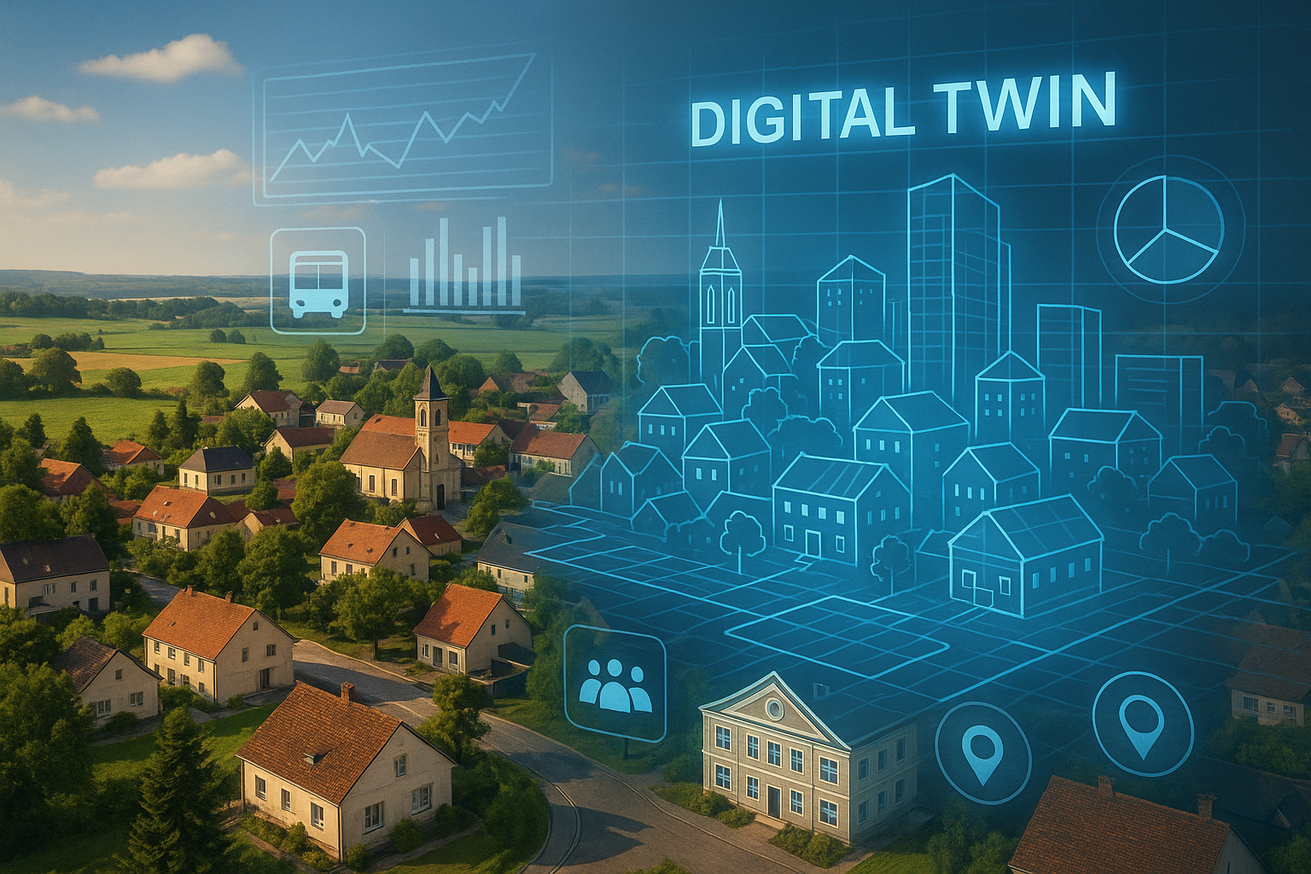
The DiTKo project – Inclusive Digital Twin for Small Municipalities – addresses precisely this challenge. Its objective is to translate the smart city concept into the context of rural areas by designing an approach that is accessible, participatory, and practice-oriented. The digital twin is deliberately conceived as a lean solution: it is intended to consolidate municipal data, simulate various scenarios (e.g., construction of new community buildings, mobility options, network infrastructure expansion, or barrier-free pathways), and visually present potential planning options. This enables collaborative discussion among representatives of municipal administrations, city councils, citizens, and local businesses. Such a participatory process is essential to fostering trust, acceptance, and a shared understanding of local developments and decision-making.
The project focuses on the notion of a “Smart Region” or “Smart Municipality”—not as a large-scale technological framework but as an actionable tool designed to support decision-making processes, enhance citizen participation, and improve the comprehensibility of future planning. In doing so, the project explores how smart city methodologies can be adapted to the context of small municipalities and how digital twins can generate tangible impact in rural regions.
The Project & Research Intern – Your Role and Responsibilities
As a participant in this internship, you will actively contribute to shaping the initial stages of the project. This includes:
Empirical Foundation & Pilot Municipalities
Initiating contact and cooperation with pilot municipalities
On-site data collection (e.g., geodata, demographic data, infrastructure information)
Conducting qualitative needs assessments through interviews, surveys, and workshops (with a focus on inclusion)
Conceptualization & Analysis
Assessment of needs and development of a scenario catalog
Scientific literature review of national and international research, including systematic analysis and conceptual development of a municipal digital twin architecture
Review of existing digital twin approaches and evaluation of their applicability to small municipalities
Scientific groundwork for the development of the first prototype (digital twin)
Participatory Formats & Co-Creation
Preparation and contribution to workshops
Documentation and analysis of participation processes
Development of approaches for inclusive and low-barrier user interaction
The tasks listed above will be divided between two different teams, one of which will operate in German (interaction with stakeholders will be conducted in German). The scientific literature review, conceptual work, and prototype development may be conducted in either German or English.
If you want to understand how innovation can emerge in rural areas – and how research can directly shape municipal practice – this project offers a unique opportunity to actively contribute. Not all of these points are mandatory – curiosity, team spirit, and a willingness to explore new topics are the most important qualities.
Requirements for Participants
Basic knowledge of data analysis, data cleaning and visualization
Experience with common data formats (CSV, JSON, XML; geodata is an advantage)
Interest in AI-based scenario simulations and Digital Twin concepts
Fundamental skills in Python, R, or similar languages (e.g., for prototyping or data processing)
Basic knowledge of SQL or geodata processing (e.g., QGIS, GeoJSON) is beneficial
Interest in qualitative and quantitative data collection (interviews, workshops, surveys)
Basic knowledge and understanding of systematic and structured literature analysis and desk research
Ability to analyze municipal needs and structure findings clearly
Willingness to document research outcomes in a comprehensible way (e.g., scenario catalogue)
Motivation to work with municipalities and local stakeholders
Willingness to participate in workshops and citizen engagement formats
Open, dialogue-oriented mindset – also when working with non-technical audiences
Ability to present results clearly (presentations, visualizations, documentation)
Reliable working style and independent time management
Ability to collaborate within interdisciplinary teams (e.g., IT, administration, social sciences)
Interest in practice-oriented research with societal relevance
Technical Understanding & Data Competence
Methodological & Empirical Work
Cooperation & Communication
Project & Teamwork Skills
Not all of these points are mandatory – curiosity, team spirit, and a willingness to explore new topics are the most important qualities.
Your Benefits
You will contribute to a real Digital Twin pilot project in a rural setting – with direct practical relevance.
You will learn how Smart City technologies and AI methods can be adapted for small municipalities.
You will gain insights into scientific literature analysis, data analysis, scenario development, visualization and citizen participation.
You will help develop innovative solutions for municipal future planning – in collaboration with local stakeholders.
You will build a unique profile at the intersection of computer science, society and public administration – a highly relevant future field.
We look forward to an exciting collaboration!
UNIVERSITY OF KOBLENZ
Universitätsstraße 1
56070 Koblenz
© Universität Koblenz