UNIVERSITY OF KOBLENZ
Universitätsstraße 1
56070 Koblenz

Dear alumni,
In today’s edition of the newsletter, we have once again selected topics for you from the university’s various faculties and departments.
Did you know that the University of Koblenz also offers opportunities for further academic study through distance-learning programmes? The ZFUW currently offers six Master’s programmes for further education and 20 certificate courses; you can read more about them here.
The team behind the research project “Images of Rural Diversity” took a look at cultural development in rural areas. Around 600 photographs were collected and analysed, and the findings were discussed with cultural practitioners and experts to develop recommendations for action.
From the coming winter term, students will once again be able to study Fine Art as part of the teacher training programme after a long hiatus.
The Bio-Geo Alumni Student Night will take place again this year, for the first time in collaboration with the FIT4SukCESS project, which will allow for keynote presentations and discussions in English.
Finally, we would like to make a personal request: We’d be interested to hear your views on the newsletter and the topics covered, and what other topics you’d like to see included. We’ve put together a (very) short questionnaire that will be online until october 18th. We look forward to your feedback!
Your team at the Central Alumni Office
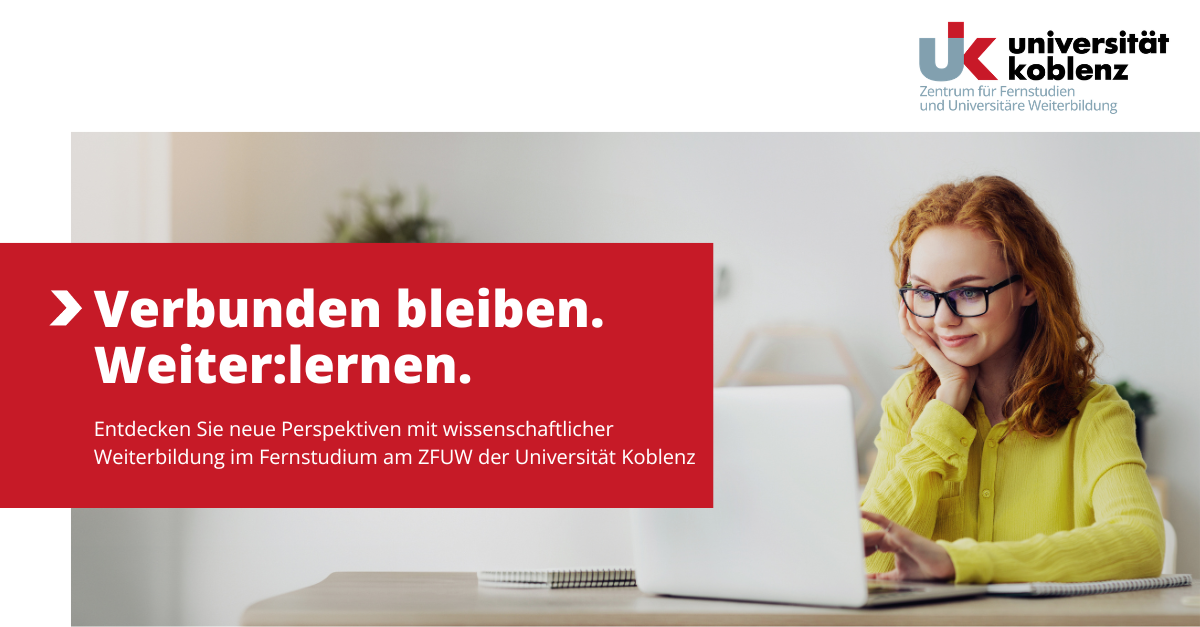
Lifelong learning is a key factor in personal development and professional success. Further academic education combines the latest research with practical knowledge, enabling students to deepen their understanding in specific areas, develop their skills and explore new fields of study.
In addition to its Bachelor’s and Master’s degree programmes on campus, the University of Koblenz also offers a diverse range of scientific further education programmes specifically designed for those already in employment and with professional experience. With currently six Master’s programmes in further education and 20 certificate courses in the fields of Natural Sciences & technology, as well as human sciences and management, the portfolio opens up numerous opportunities for specialists and managers across a range of professional fields.
Studying alongside work and family life – how can it be done?
The University of Koblenz’s scientific further education programmes are organised as part-time distance learning courses in a blended-learning format. The programme centres on a combination of guided self-study, digitally supported interaction and supplementary face-to-face sessions. The course content is made available via a digital learning platform and is largely studied independently with the aid of a variety of teaching and learning materials. Regular interaction with lecturers and fellow students, as well as accompanying online and face-to-face sessions, support the learning process and promote practical relevance. This structure provides a reliable framework whilst also offering the freedom to adapt the pace of learning to suit individual needs. In this way, students and course participants benefit from a high degree of flexibility in terms of time and location, enabling them to balance their studies, work and personal commitments effectively.
The programmes are organised and administered by the Centre for Distance Studies and Continuing Education (ZFUW), a central institution of the University of Koblenz. The ZFUW acts as a competent point of contact for distance learners throughout their studies and ensures personalised and professional supervision from a single source, from initial advice through the application process and the course itself right through to the successful completion of the degree or certificate.
Have we sparked your interest? Then take the next step in your professional and personal development. Find out more about our continuing professional development programmes here and remain an active part of the University of Koblenz community.
Just how diverse is culture in rural areas – and who is visible as part of cultural life? These were the questions addressed by the research project ‘Images of Rural Diversity’ at the University of Koblenz. The project was funded by the Federal Ministry of Agriculture, Food and Home Affairs (BMLEH) under the funding guidelines ‘Factor K – Research into the Cultural Factor in Rural Areas’. The research examined which images of rural life, rural culture and local cultural actors are conveyed, and how the social diversity of rural areas is reflected in them.
The project involved collecting and analysing around 600 photographs from the context of local cultural work in three rural regions in Rhineland-Palatinate, Mecklenburg-Western Pomerania and Lower Saxony. Initially, this revealed a rather homogeneous picture of the players depicted. The project therefore conducted a more in-depth investigation, focusing in particular on the visibility and positioning of children and young people, people with a migration background and BIPoC, as well as processes of rural transformation.
The findings highlight various issues. Children and young people are often addressed as participants or ‘the next generation’ in cultural programmes, but are less frequently given the opportunity to shape these programmes themselves and take on responsibility. Diversity stemming from migration, on the other hand, is still sometimes presented as something ‘special’ in cultural programmes. At the same time, the research highlights the growing sense of initiative amongst people with a migration background and BIPoC, and thus the potential for a ‘post-migrant’ rural landscape. Finally, it became clear just how important culture is for local communities and a sense of belonging – and how traditions must, at the same time, be further developed so that diverse groups of people can participate in them.
The findings were discussed in depth throughout the course of the project with cultural practitioners from the regions under study, as well as with experts. This led to specific recommendations for action aimed at ensuring cultural work is sensitive to diversity. A key finding was that openness and good intentions alone are not enough to enable cultural participation for different sections of the population. Opportunities for genuine participation are needed, as is the removal of structural, social, communicative and architectural barriers.
To ensure that the findings remain useful in practice even after the project has ended, the project team has, amongst other things, developed the free digital reflection course ‘Culture in rural areas with everyone’ (available in German). A detailed project report containing image analyses, findings and recommendations for action will be published in 2027.
From the coming winter semester, the University of Koblenz will once again offer the opportunity to study Fine Arts as part of the teacher training programmes for primary schools, Realschule Plus and Gymnasium (Sek I and Sek II, excluding BBS).
The study programme comprises the areas of art practice, art history and art education, which will form part of the study programme with varying degrees of emphasis. The largest component is art practice, which focuses on education to develop a sense of identity as an artist. The disciplinary component of the study programme is taught within the field of art history, where interdisciplinary courses will also be regularly offered. Art education reflects on artistic processes, theories and practices in relation to art teaching, thereby complementing both art practice and art history with further theoretical perspectives (feminist, anti-discrimination, etc.) as well as artist-researcher methods.
Click here for further information.
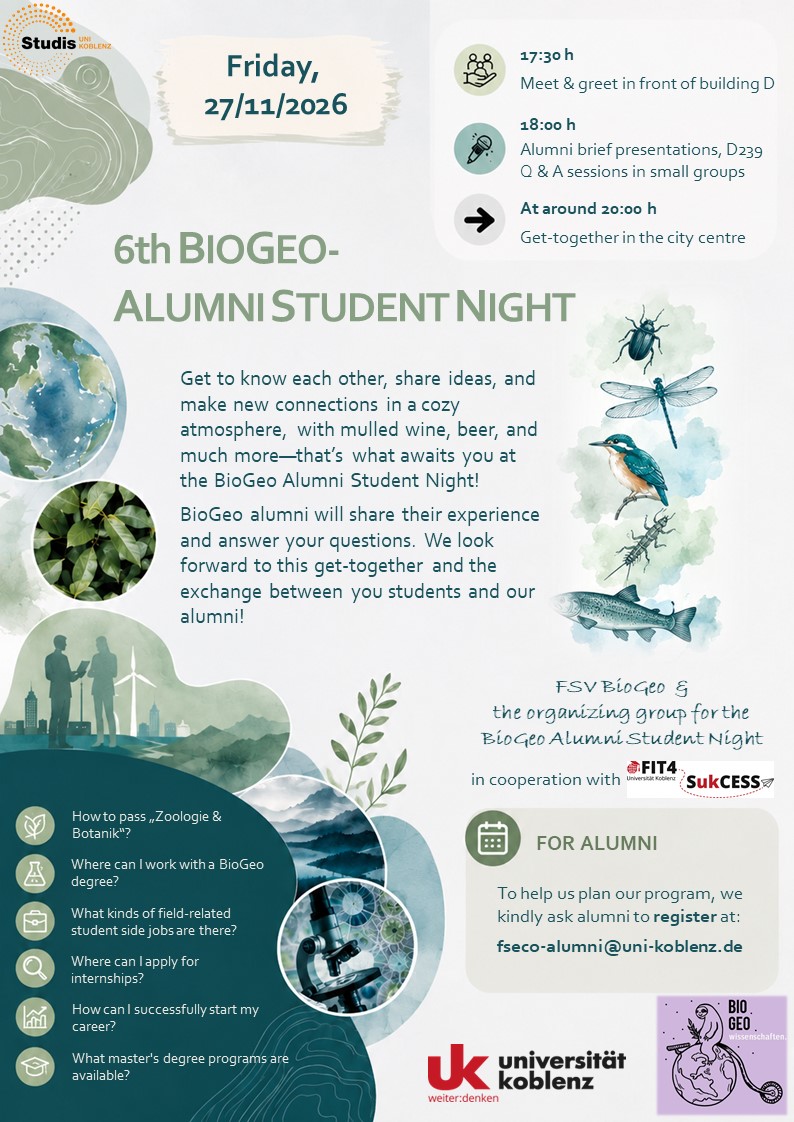
On November 27, 2026, the Bio-Geo Alumni Evening will take place once again, providing an opportunity for students and alumni to connect. There will be a varied program once again.
Interested alumni are asked to register with the student council by October 31, 2026: fseco@uni-koblenz.de
BioGeo alumni can also sign up for the student council’s mailing list at the same email address.
UNIVERSITY OF KOBLENZ
Universitätsstraße 1
56070 Koblenz
© Universität Koblenz