Visit profile
Microcosm
Experience microbiology and genetics at the University of Koblenz - student labs
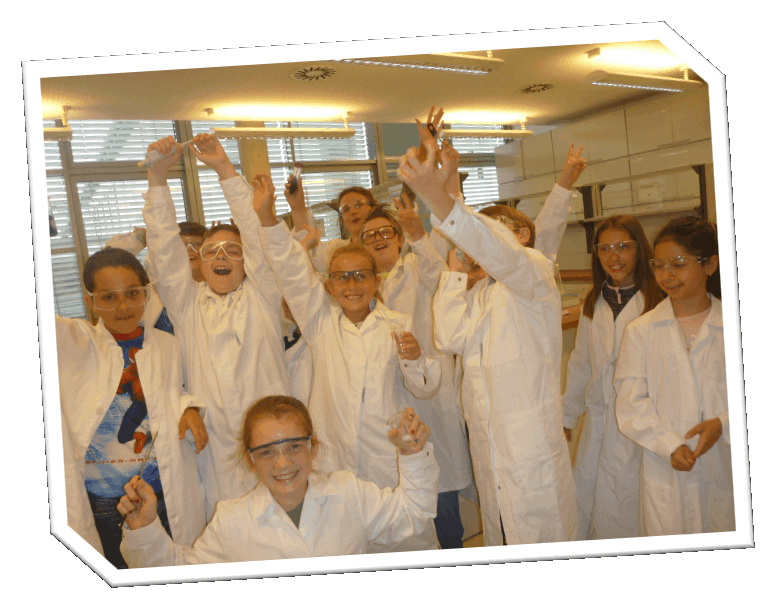
The student laboratories in the field of microbiology and genetics were initiated and continuously developed by Jutta Meier as part of her final theses in the microbiology working group. They are aimed at school classes from orientation level to upper secondary school as well as pupils from vocational schools. A teacher training course has also already been successfully organised.
The labs are usually offered with two to four school classes per day. Depending on the topic of the final theses, targeted interdisciplinary cooperation also takes place - for example with Faculty 2 (Institute of English and American Studies, CLIL Academy, MoSAiK project) or Faculty 1 (Institute of Psychology, MoSAiK project). The implementation of individual programmes was also supported by external funding, for example from the company Zschimmer & Schwarz.
The student labs are always flanked by accompanying research, including master's theses and a doctorate, which is supported by university funding to strengthen interdisciplinary research. Various aspects are investigated, such as subject-related learning, language development or motivational-affective effects.
We provide regular information about specific programmes via the Campus Schools Network mailing list. Interested students and schools can also contact us directly at any time at the following address: yvonnewerle(at)uni-koblenz.de (central contact address to follow)
Final theses to date
Autor | Thema |
|---|---|
Ricarda Diedrichs | Supporting Language Development in CLIL-Based Microbiology Education - Framing student lab courses with pre- and post-lessons to promote BICS and CALP. |
Robert Baumann | Mehr als ein außerschulischer Lernort: Eine Analyse des Beitrags von Schülerlaboren zur Förderung intrinsischer Motivation für naturwissenschaftliche Themen in Abhängigkeit vom individuellen Interesse der Teilnehmenden. |
Yvonne Werle | Educational videos in CLIL – Developing educational videos for an interdisciplinary CLIL student laboratory day on CRISPR/Cas. |
Carla Christ | Content and Language Integrated Learning (CLIL) Put into Practise in a Genetics Lab for High-School Students – Scaffolding as a Method to Promote Student Performance. |
Kevin Gorkievicz | Schüler*innen für MINT-Themen interessieren – Eine Analyse von Schülerlaboren zu Mikrobiologie und Genetik durchgeführt am Campus Koblenz der Universität Koblenz-Landau. |
Sevgi Gürkaynak | Wirkung von Antibiotika Konzeption, Durchführung und Evaluation eines Schülerlabors für die gymnasiale Mittelstufe. |
Sarah Schneider | Lehrerfortbildung zu dem Thema CRISPR/Cas9. |
Jannika Gier | Schülerlabore als Interesse fördernde Lernumgebung - Experimentieren mit Schülerinnen und Schülern der Orientierungsstufe zum Thema „Wer oder was sind eigentlich Bakterien - unsere Freunde oder Feinde?“ |
Ricarda Sonnenberg | Fördern Schülerlabore das Interesse an Naturwissenschaften? – Konzeption, Durchführung und Evaluierung eines Schülerlabors zum Thema Bakteriendiagnostik. |
Nils Klein | Molekularbiologie für die Oberstufe: Entwicklung und Durchführung von Schülerversuchen zu PCR und Restriktion im Campus-Labor. |
Research focus: GENglish - learning English with the gene scissors
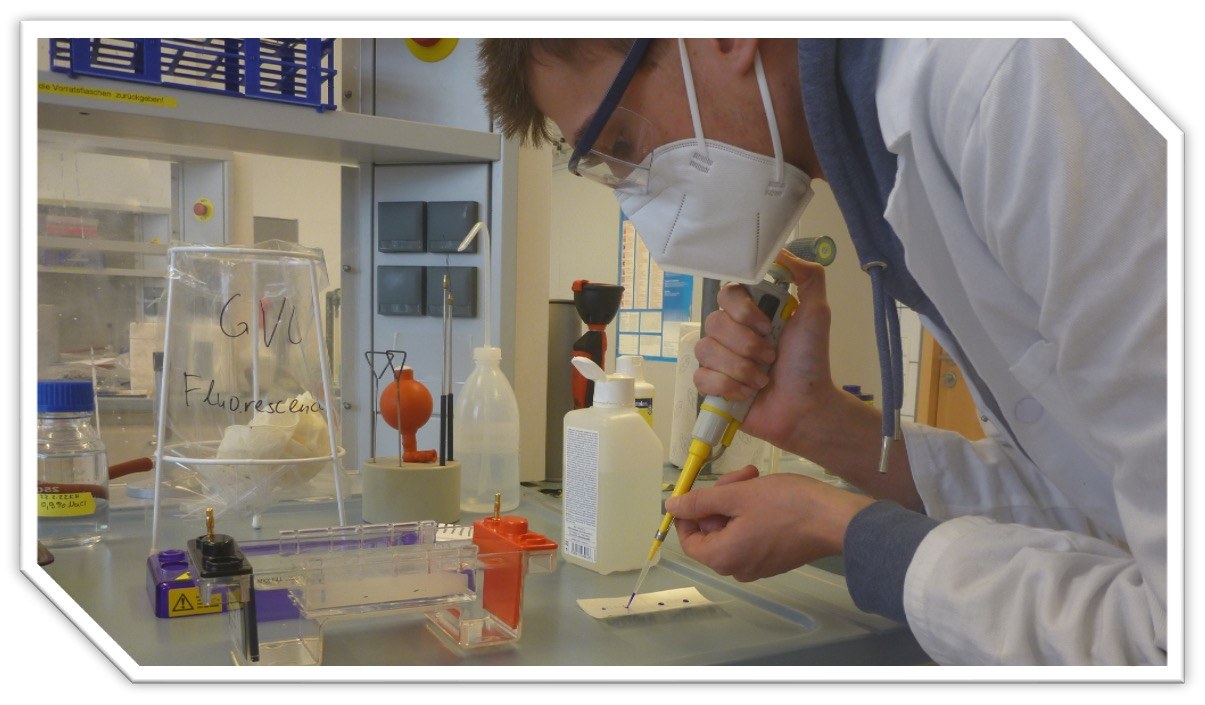
In the CLIL student lab, students work in the lab with the CRISPR/Cas gene scissors - and mainly in English. The aim is to combine specialised learning in the field of molecular biology with the funding of English language skills in a Natural Sciences context. The project is a cooperation between the microbiology working group and the Koblenz CLIL Academy.
The course format has a modular structure and is aimed at different target groups: Participants include trainees as biological-technical assistants (BTA), students on genetics laboratory courses and secondary school pupils. While trainees and students can deepen their existing laboratory experience, pupils from general education schools are gradually introduced to laboratory work with the help of preparatory materials before carrying out the experiments largely independently in the laboratory. The modular structure consists of a preparatory unit (optional), a two-day laboratory course and a follow-up unit (optional).
The German language remains present in the course - because the aim is to develop bilingual expertise. Language support, structured materials and targeted scaffolding strategies help to develop confidence in using technical language in both languages.
In this way, the student laboratory combines professional practice with language education - and prepares students specifically for the requirements of an increasingly multilingual professorship appointment and study environment.
Contact: yvonnewerle@uni-koblenz.de
Participating members of the AG Microbiology
UNIVERSITY OF KOBLENZ
Universitätsstraße 1
56070 Koblenz
© Universität Koblenz