UNIVERSITY OF KOBLENZ
Universitätsstraße 1
56070 Koblenz
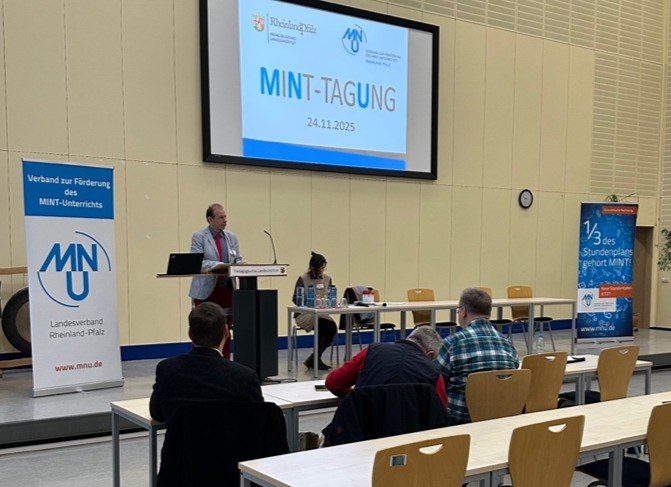
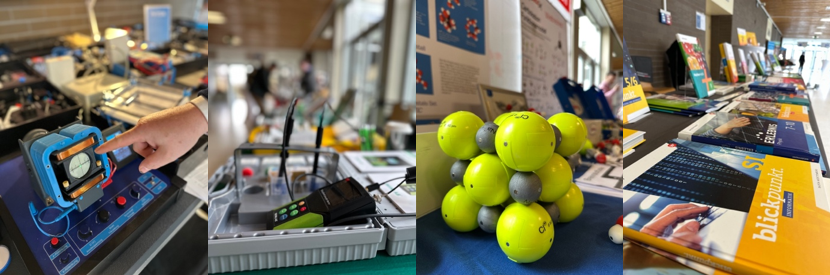
On 24 November 2025, the Pädagogisches Landesinstitut Speyer hosted the STEM Conference 2025 of the Rhineland-Palatinate MNU regional association. Primary and secondary school teachers were able to discover innovative approaches in ten practice-orientated workshops. The variety of topics offered every teacher exciting insights and new ideas for their own lessons. The program was complemented by an exhibition of teaching and learning materials, which was set up in the foyer of the Pfalz Kolleg.
After a welcome address by the regional chairman, Dr Alexander Hug, the conference opened with a lecture by Prof Dr Stefan Müller (University of Koblenz, Chemistry Department). Under the title “Trust is good, understanding is better: Why and how Nature of Science belongs in STEM lessons” (German original: Vertrauen ist gut, Verstehen ist besser: Warum und wie Nature of Science in den MINT Unterricht gehört), the speaker illustrated how a reflective understanding of science enables learners to engage critically with fake news, AI generated content and controversial findings. He discussed what ideas pupils have about Natural Sciences in general and presented practical teaching approaches that can be used to systematically integrate Nature of Science into subject lessons.
Our working group, with Sarah von Styp Rekowski representing us on site, contributed a workshop titled “Small robots, big impact – playful programming with Ozobots” to the conference program (German original: Kleine Roboter, große Wirkung – Spielerisch programmieren mit OzoBots). Primary school teachers were able to learn how to use the OzoBots in practice and reflect on the possible applications in science lessons. Another workshop for the primary level with the topic "Learning begins with amazement - and grows through language - integrated language education and natural sciences thinking in the context of sustainability in primary school science lessons" was offered by colleague Dr Ulrike Eschrich, Institute of Primary School Pedagogics (German original: Lernen beginnt mit Staunen – und wächst durch Sprache – Durchgängige Sprachbildung und naturwissenschaftliches Denken im Kontext von Nachhaltigkeit im Sachunterricht der Grundschule)
Secondary school teachers, for example, learnt how to use digital simulations to teach complex biological processes in a motivating, safe and resource-saving way. In a Calliope workshop, on the other hand, specific teaching sequences were developed to introduce algorithmic thinking and interdisciplinary Computer Sciences. Another offer was dedicated to the use of AI tools for educational scenarios, for the creation of teaching materials, for experimentation and for examination formats. This contribution was made by Prof Dr Martin Bracke (Mathematics Institute), Prof Dr Stefan Müller (Chemistry Department) and Dr Johannes Lhotzky (Johannes Gutenberg University Mainz). "AI-supported, formative feedback in computer science lessons for the funding of linguistic competences" was the title of a contribution to the computer science teaching programme (German original: KI-gestütztes, formatives Feedback im Informatikunterricht zur Förderung sprachlicher Kompetenzen). The programme was supplemented by practical formats on space travel materials, working with life and research stories of female scientists and recognising logical fallacies in everyday texts.
The successful synthesis of knowledge transfer, networking and creative concepts made the conference a real spark for MI(n)T innovations.
UNIVERSITY OF KOBLENZ
Universitätsstraße 1
56070 Koblenz
© Universität Koblenz